
Working from Home Pros and Cons: What Really Matters for Working from Home
Anyone who opens their laptop in the morning before their first coffee is ready knows the feeling. No commuting, no distractions from office noise, no meetings that turn into time-wasters. That sounds tempting. And sometimes it is.
But the picture isn’t complete. Working from home can just as easily mean: isolation, lack of equipment, a refrigerator that’s constantly tempting, and the strange inability to truly stop working after 6 PM. The truth, as often is the case, lies somewhere in between – and heavily depends on who you are, what you do, and how the company structures the framework conditions.
This article shows what working from home truly means in 2026. For employees, for managers, for HR professionals.

As a Digital Marketing Working Student, she ensures that Schrankerl is a delight online as well. With fresh ideas, great commitment, and a digital flair, she brings creativity and energy to the team — and to every screen! 💚
What Working from Home Means: Definition, Remote Work, and Hybrid Work Compared
In German-speaking countries, the term ‘Homeoffice’ describes the possibility of working from home – partially or fully. The employee remains part of the team, has fixed working hours, but is not in the office daily. Legally and under labor law, there are significant differences depending on the country and company agreement.
Remote work goes further. Here, people work completely independently of location, often without a fixed workplace. These can be digital nomads, but also employees who never have to come into the office – regardless of whether they are 30 kilometers or 3,000 kilometers from the nearest office.
Hybrid work is the mixed form: a few days in the office, a few days working from home. This variant has become the new standard in many companies after the pandemic.
Working from Home Advantages: What Employees and Companies in Austria Truly Gain
No Commute, More Time
One of the strongest arguments for working from home is commuting. Anyone who commutes an hour daily loses about 220 hours a year. That’s almost nine full working days. Working from home gives this time back, allowing more room for sleep, exercise, family, or simply a calm start to the day.
Furthermore, commuting is exhausting. Public transport during rush hour, overcrowded trains, and stalled cars on the highway drain energy before the actual work even begins. Those who start their workday rested and without traffic are simply more productive.
More Focus – If Conditions Are Right
Open-plan offices are detrimental to productivity. Studies show that office employees are interrupted an average of 15 times per hour, which can often lead to frustration and overwhelm. A well-equipped home workspace and clear boundaries to the outside world can counteract this.
Of course, this doesn’t apply to every household. For example, someone sitting in the living room with children will have a different experience than someone who has a quiet study available.
Flexibility That Makes a Real Difference
Not all work has to be done between 9 AM and 5 PM. Working from home allows individuals to work during their personal peak performance times – some people are sharpest at 7 AM, others only after lunch. This rhythm can hardly be maintained in an office.
At the same time, working from home makes it easier to coordinate personal appointments: doctor’s visits, tradespeople, school events. This reduces stress and increases overall job satisfaction.
Cost Savings for Both Sides
Employees incur fewer expenses for travel, eating out for lunch, and work clothing. Companies save money as they require less office space, resulting in lower operating costs. Smaller businesses, in particular, benefit from this.
Working from Home as a Recruiting Argument
Companies that offer working from home attract a larger pool of applicants. The ties to a specific location are eliminated or at least loosened. For many companies, this is no longer a nice-to-have, but a prerequisite in the competition for skilled workers.
Working from Home Disadvantages: What Is Often Underestimated When Working from Home
Social Isolation
The office is not just a workplace. It’s a social space. The quick chat at the coffee machine, lunch with colleagues, the casual conversations between meetings – all of this is missing when working from home. This can be stressful in the long run and lead to dissatisfaction and a feeling of exclusion. Studies from the post-pandemic era show that the feeling of isolation and the lack of genuine interpersonal moments are the most common criticisms from remote employees.
Boundaries Blur
Another weakness of working from home is that the separation between professional and private life becomes more difficult. In the office, you go home. At home, work doesn’t stop. The commute home as a transition is gone. This constant availability, lack of physical separation between work and living spaces, and the feeling of never truly being ‘off work’ are real risks to mental health.
Career and Visibility Disadvantages
Those who are not in the office are less noticed. The reason is that spontaneous conversations with superiors, presence during important informal moments, and casually talking about projects happen in the office, not in an online chat. Physical absence during such moments can be an invisible brake on certain career advancements.
Technical Infrastructure as an Underestimated Problem
Poor Wi-Fi, no ergonomic desk, no second monitor, no quiet room – these are problems that seriously hinder productive work. Not every apartment is suitable as an office. Employers who ignore this and simply ‘approve working from home’ without offering support don’t solve the problem – they merely shift it.
Leading Remotely Is a Discipline of Its Own
Many managers were never trained to lead teams remotely. Control through physical presence no longer works. Instead, it requires clear goals, regular communication, genuine trust, and the intuition to know when someone on the team is struggling without saying so.
Health When Working from Home: Movement, Nutrition, and Psychological Strain
Lack of Movement
Those who commute to the office automatically move more: walks to the subway, stairs, walking between meetings. When working from home, the radius of movement is reduced to the distance between the bedroom and the desk. This has consequences such as back pain, neck problems, and fatigue due to lack of exercise. These complaints demonstrably increase when working from home if nothing is actively done to counteract them. Even short walks, regular stretching breaks, and possibly a standing desk are helpful and make a difference.
Nutrition When Working from Home
If there’s no structure when working from home, people are quicker to grab snacks, eat in front of the computer, or forget their lunch break entirely. Yet, the lunch break is particularly important in the daily working-from-home routine: it separates the morning from the afternoon, gives the brain a real break, and can significantly improve concentration in the second third of the day. Those who use the break to eat something proper will get through the day better and more effectively.
Mental Health: A Topic Rarely Discussed Openly
Isolation, lack of structure, the feeling of not truly being ‘part of it’ – this can take a toll in the long run. Burnout symptoms occur more frequently when working from home because boundaries are lacking. At the same time, the inhibition threshold to talk about it is higher at home than in direct conversation with colleagues or superiors.
Companies introducing hybrid work models should actively create spaces for such conversations – not just technically (video conferences), but also culturally.
Impact on Communication and Team Dynamics
Communication when working from home proceeds differently. Asynchronous instead of synchronous. Written instead of verbal. This has advantages: discussions are documented, decisions are traceable, no one is pulled out of their flow. But it also has costs.
Irony, mood, body language, quick follow-up questions on the fly – all of this is missing. Misunderstandings arise more quickly. New employees who have never truly integrated into the team have a harder time feeling a sense of belonging.
Teams that work entirely remotely need consciously planned social moments. Not as a substitute for real encounters, but as a minimal foundation for trust.
Working from Home and Productivity: What Studies Say
The study situation is indeed inconsistent. Some show that remote employees are more productive – fewer interruptions, shorter meetings, more focused time. Others show the opposite – especially for complex, collaborative tasks where spontaneous communication is crucial.
It has consistently been shown that working from home works best for focused individual tasks. It is less effective for creative teamwork and not good at all for onboarding new employees.
The answer to the question ‘Is working from home more productive?’ is therefore: It depends. On the activity, on the person, on the framework conditions.
Working from Home Tips: How to Truly Work Productively from Home
- Maintain fixed start and end times. Sounds simple, but it’s not. If you don’t define an end to your workday, you won’t have one.
- Set up your own workspace. If you work from the sofa, you’ll eventually fall asleep – or never be able to switch off there.
- Actively plan breaks. Not ‘when I’m done,’ but at fixed times. Lunch is part of that.
- Turn on your camera during video conferences. This increases accountability and ensures that facial expressions become readable again.
- Communicate proactively. If you work silently at home, no one notices. Short updates, visible results, active participation in team channels – this maintains the connection to the team.
- Go outside regularly. A short walk before or after work simulates the missing commute. This is not a luxury, but mental hygiene.
Working from Home from the Perspective of Companies and HR
For companies, working from home is no longer just an employee perk. It is a strategic tool in the competition for talent – and at the same time, a leadership task that is underestimated.
Companies offering working from home must:
- formulate clear guidelines (how many days, which roles, what expectations)
- create technical prerequisites (laptop, headset, VPN, access to tools)
- train managers
- establish trust as a foundation, not control
- maintain regular feedback channels
Working from home that only exists on paper and is accompanied by mistrust in everyday life achieves none of the promised benefits – and creates new problems.
Working from Home or Office: When Each Model Is a Better Fit for Austrian Companies
| Situation | Working from Home | Office |
|---|---|---|
| Focused Writing Work | ✔️ | |
| Complex Analyses | ✔️ | |
| Brainstorming and Creative Work | ✔️ | |
| Onboarding New Colleagues | ✔️ | |
| Important Negotiations | ✔️ | |
| Regular Routine Tasks | ✔️ | |
| Team Building | ✔️ | |
| Resolving Conflicts | ✔️ | |
| Focus Days Without Meetings | ✔️ |
Hybrid Work in Austria: Combining Working from Home and Office Effectively
Many companies have already agreed on hybrid models: two to three days in the office, the rest working from home. This sounds like the best of both worlds, provided it is implemented efficiently.
Poor implementation, for example, means that employees don’t coordinate their office days, and the office is then always half-empty. This makes the investment in office space expensive and the social component ineffective.
Successful implementation is when office days are reserved for collaborative work such as workshops, strategy, and team discussions. Working-from-home days, on the other hand, are for focused individual work. This requires clear agreements but works excellently.
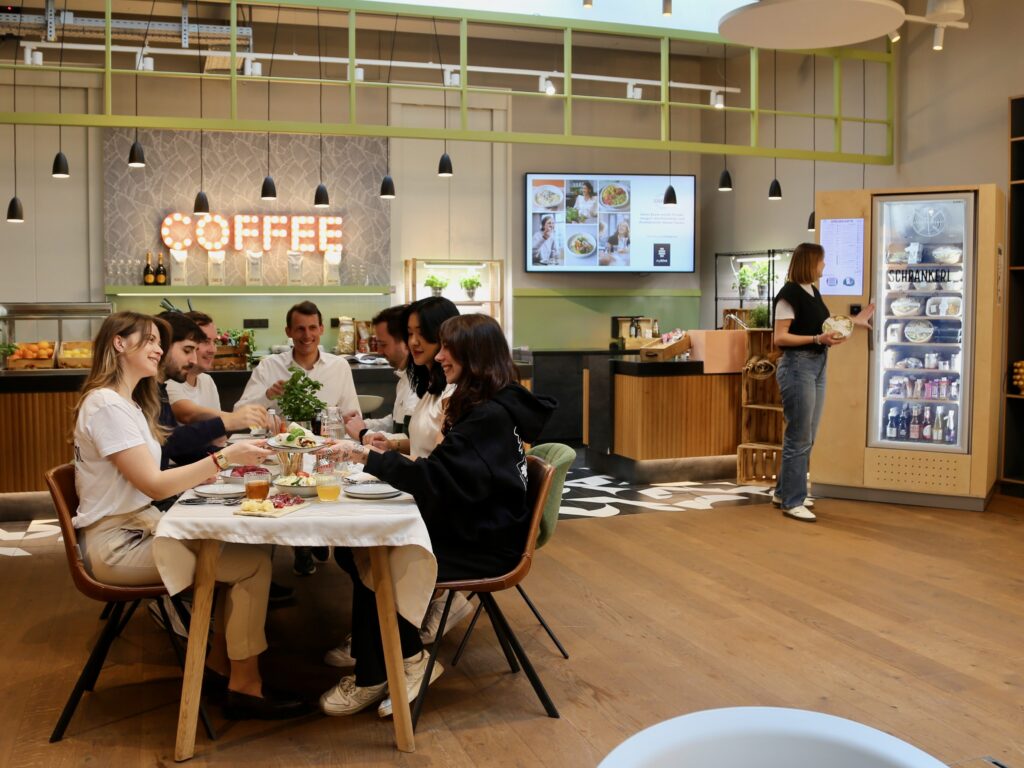
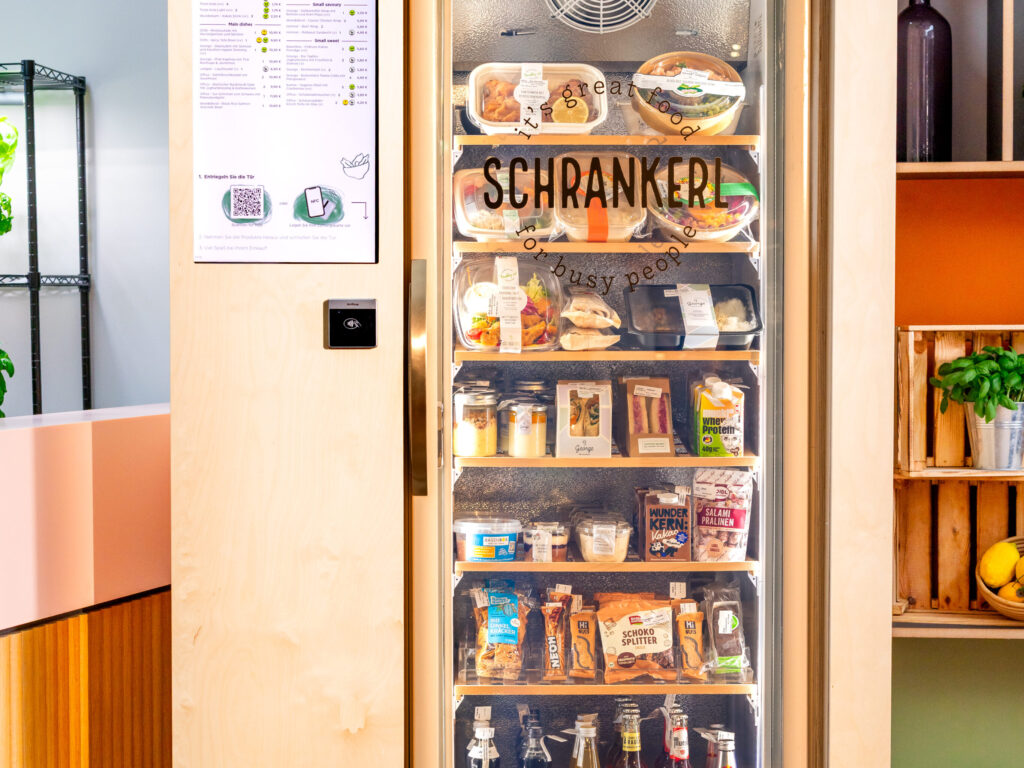
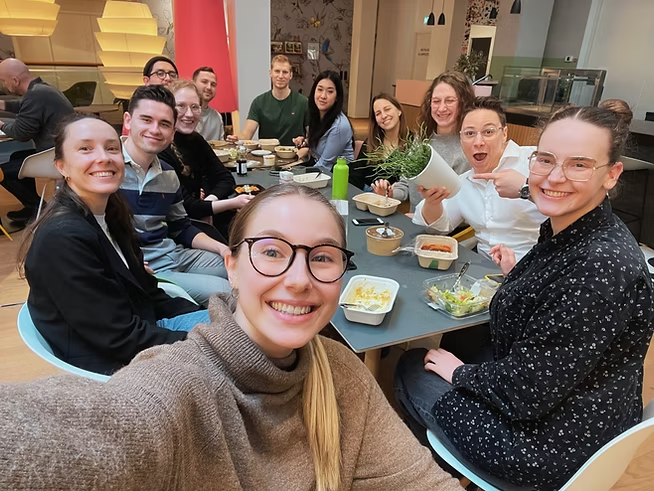
For such office days, companies often offer their employees small extras that make the in-person day more attractive. A shared lunch is one of them. If you want people to truly want to come to the office, you also have to offer something, literally. Providers like Schrankerl are designed precisely for this: healthy and fresh meals as a fixed part of the office routine, delivered directly to the company.
Are you planning hybrid work in your company? We at Schrankerl can help with lunch!

Frequently Asked Questions
In Austria, occupational health and safety laws generally apply to home offices as well. Employers are required to conduct risk assessments and provide suitable work equipment – in practice, this is often handled through cost subsidies or the loaning of equipment.
This largely depends on the nature of the work and individual personality. Many companies find that two to three days in the office per week work well. The crucial aspect is not the number of days, but how they are utilized.
In Austria, since the 2021 remote work regulations, it has been possible to establish remote work arrangements through works agreements or individual contracts. Currently, there is no statutory legal entitlement to work from home—the employer must provide their consent.
Structure helps more than willpower. Fixed working hours, clear breaks, a quiet workspace, phone stacking (smartphone in another room), and consciously turning off notifications during focus times are proven methods.
Ideally with planning. Those who know what’s for lunch are less likely to reach for a quick snack. Weekly shopping lists, fixed break times, and consciously leaving the workspace to eat help supply the body with energy without keeping your mind on work.
Take active countermeasures: regular video calls even without an agenda, virtual coffee breaks, using coworking spaces, and a clear separation between work and leisure time. Anyone who notices that isolation is becoming a burden should address it openly—with colleagues or supervisors.
As a Digital Marketing Working Student, she ensures that Schrankerl is a delight online as well. With fresh ideas, great commitment, and a digital flair, she brings creativity and energy to the team — and to every screen! 💚
More Articles
Anyone who opens their laptop in the morning before their first coffee is ready knows the feeling. No commuting, no distractions from office noise, no meetings that turn into time-wasters. That sounds tempting. And sometimes it is.
But the picture isn’t complete. Working from home can just as easily mean: isolation, lack of equipment, a refrigerator that’s constantly tempting, and the strange inability to truly stop working after 6 PM. The truth, as often is the case, lies somewhere in between – and heavily depends on who you are, what you do, and how the company structures the framework conditions.
This article shows what working from home truly means in 2026. For employees, for managers, for HR professionals.