Employee Benefits: The Best Employee Benefits in Austria 2026
The job market has fundamentally changed. Today, qualified professionals have choices and no longer focus solely on salary when selecting an employer. What matters is the overall package: How does the employer treat me? What do I receive in addition to my pay? Can work and life truly be balanced at this company?
Employee benefits are no longer just a nice perk; they are a strategic tool for recruiting, employee retention, and employer branding. Companies that understand and consistently implement this will win the battle for top talent. Those who ignore it will lose, and with them, their skilled professionals.
In this blog, we show which benefits are truly in demand and tax-attractive in Austria, and what common mistakes companies make.
What are Employee Benefits?
Employee benefits (also known as employee advantages, corporate benefits, employee offers, or employer services) are all additional services that an employer offers to their employees beyond the agreed-upon salary.
These include traditional non-cash benefits such as meal subsidies or company cars, flexible working hour models and further training opportunities, as well as modern benefits like mental health programs, climate tickets, or company pension schemes.
The crucial difference from salary: Many benefits are tax-advantaged for both employers and employees, making them particularly efficient.
Why Employee Benefits Are Becoming Increasingly Important
Austria has been experiencing a structural shortage of skilled workers for years. In interviews conducted by the Wirtschaftsforum der Führungskräfte (WdF), the majority of surveyed managing directors and HR managers stated that attracting qualified employees is the biggest challenge for the coming years.
At the same time, expectation levels have changed:
- Generation Z places particular emphasis on flexibility and meaningfulness as standard in daily corporate life.
- Experienced professionals prioritize health benefits, work-life balance, and long-term security.
- Remote-experienced employees expect home office and mobility benefits – even after the pandemic.
Companies that offer attractive benefits demonstrably profit from:
- Higher employee satisfaction and retention
- Lower turnover (and thus lower recruiting costs)
- Better employer branding and a stronger talent pool
- Higher productivity through healthier and more motivated teams
The 15 Most Popular Employee Benefits in Austria
1. Flexible Working Hours
Description: Flexitime, trust-based working hours, 4-day work week, or individual working hour models that adapt to employees’ life situations.
Advantages for the employer include increased attractiveness as an employer, better utilization, and fewer employee absences. In addition to the positive effects on the company, there is also a significant advantage for employees: a balanced work-life balance.
Implementation: Define clear core working hours, introduce digital time tracking, train managers for results-oriented leadership.
2. Home Office and Hybrid Work
Description: The option to perform part of the work from home or another location.
This leads to lower office costs, higher employee satisfaction, and a broader recruiting radius for companies. For employees, the commute is eliminated, and concentration and autonomy are increased.
Implementation: Document home office policy in writing, ensure technical equipment, consider legal frameworks (in Austria: home office lump sum).
3. Meal Subsidies and Company Catering
Description: Subsidies for meals – whether through vouchers, digital solutions, or direct canteen/catering within the company.
For the employer, this employee benefit is advantageous because it is tax-advantaged, highly valued by employees, and used daily. This employee offering is tax-free up to €8.00 per working day. The benefits for employees range from financial savings and healthier eating to improved concentration and motivation after meals at the workplace.
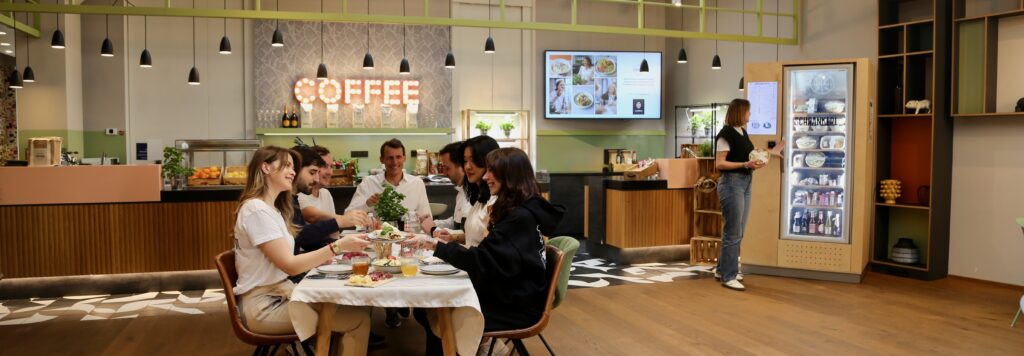
Implementation: Meal vouchers, digital meal tokens, cooperation with catering companies, or – particularly effective – in-house catering directly at the company through providers like Schrankerl.
➡️ Schrankerl delivers freshly prepared, healthy meals directly to the office – uncomplicated, sustainable, and tax-advantaged. More than 140 Austrian companies already rely on this type of office catering.
4. Climate Ticket and Mobility Benefits
Description: Assumption or subsidization of the Austria Climate Ticket or other public transport; alternatively, job bike leasing, e-bike promotion, or commuting allowance.
Companies benefit from a sustainability image, tax advantages, and a contribution to CO₂ reduction. Employees, in turn, save costs and receive a contribution to their mobility.
Implementation: Employer can cover the Climate Ticket tax-free if it is used for commuting to work.
5. Further Training and Learning Budget
Description: Coverage of costs for courses, certifications, seminars, or a fixed annual budget for individual further training.
This benefit contributes to higher team competence, stronger employee retention, and investment in the company’s future. Employees gain opportunities for personal development, better career prospects, and a sense of appreciation.
Implementation: Define a clear per-head training budget, simplify the application process, use e-learning platforms as a low-threshold entry point.
6. Health Programs
Description: Company fitness programs, gym memberships, yoga classes, corporate health promotion, or preventive medical check-ups.
Key advantages of this benefit for the employer include fewer sick days, higher productivity, and a positive employer image. Health programs create added value for employees through free or discounted access to health services.
Implementation: Establish partnerships with local gyms or a sports membership like myclubs, utilize corporate health promotion programs via AUVA or WKÖ.
7. Mental Health Support
Description: Access to psychological counseling, Employee Assistance Programs (EAP), coaching, or digital mental health apps.
This offering signals an appreciative corporate culture that actively promotes employees’ psychological well-being, thereby preventing burnout and long-term sick leave. Employees gain low-threshold support during difficult phases.
Implementation: Engage EAP providers, communicate anonymous counseling options, sensitize managers to the topic.
8. Additional Vacation Days
Description: More vacation than legally required – for example, after the 3rd year of service, as special leave for moving or childbirth, or as a general additional offer.
Advantages for employers include low costs with high value and a differentiating factor in recruiting. Additional vacation days positively impact employee well-being by providing more time for rest and a better work-life balance.
Implementation: Document in employment contract, establish clear rules for application.
9. Company Pension Scheme (bAV)
Description: Employer contributes to a company pension fund or future provision.
This benefit offers a tax advantage for companies and a strong signal of long-term commitment. Employees also receive a tax benefit (up to €300/year tax-free within the framework of future provision) and additional old-age provision.
Implementation: Organize via pension fund or company collective insurance.
10. Corporate Benefits Platforms
Description: Digital platforms through which employees receive discounts and benefits from hundreds of partner companies.
This is advantageous for the employer as it provides a wide range of offers at low cost and with easy administration. The offering of benefit platforms provides employees with concrete price advantages in everyday life, for example, for electronics, travel, fashion, and gastronomy.
Implementation: Evaluate providers such as Corporate Benefits Austria, Edenred, or similar.
11. Family-Friendly Benefits
Description: Support for childcare (subsidies, cooperation with kindergartens), parental leave models, flexible return after parental leave.
This offering positively impacts companies, as family-friendly benefits lead to a better return rate after parental leave and the retention of young families. Employees benefit by receiving financial relief and security during the parental phase.
Implementation: Childcare subsidy up to €2,000/year is tax-free; examine cooperation with childcare facilities.
12. Company Phone and Tech Equipment
Description: Company laptop, smartphone, or headset – possibly also for private use.
Tech equipment helps employees work more flexibly and be more accessible. If employees are also allowed to use the technical equipment privately, this results in significant cost savings.
Implementation: Clear policy for private use, consider BYOD alternatives.
13. Home Office Equipment Allowance
Description: One-time or ongoing allowance for setting up the home workstation (desk, chair, monitor, etc.).
A home office equipment allowance enables higher employee productivity when working from home, as well as direct financial support for an ergonomic workstation.
Implementation: Up to €300 can be granted tax-free as a home office equipment lump sum.
14. Team Events and Social Benefits
Description: Company outings, shared lunches, sports events, Christmas parties, or informal team gatherings.
This benefit contributes to strengthening team cohesion and corporate culture. It also increases social connection within the team and provides more fun and variety.
Implementation: Define budget per employee, plan activities regularly.
15. Employee Discounts and Gratifications
Description: Discounts on own products or services, birthday vouchers, anniversary bonuses.
High employee appreciation at comparatively low costs are among the advantages of employee discounts and gratifications. For employees, this leads to direct financial benefits and a feeling of appreciation.
Implementation: Communicate as part of a structured benefit system.
Which Employee Benefits Are Particularly in Demand?
Health and Nutrition
The topic of health has become increasingly important in recent years, not only in leisure time but especially in professional life. Employees today expect companies to actively contribute to maintaining health – not just with fruit baskets and water dispensers.
Particularly in demand are:
- Corporate health promotion and preventive medical check-ups
- Healthy and freshly prepared meals at the workplace
- Support for sports activities
- Access to psychological counseling
Healthy and fresh employee catering directly within the company – as offered by Schrankerl – is a particularly effective tool: It is used daily, is visible, and directly impacts employees’ energy and concentration.
Flexibility
Flexible working hours and home office are no longer benefits in the classic sense in 2026 – they are a basic prerequisite for being competitive in recruiting at all. Companies that do not offer hybrid work will lose candidates to those that do.
In addition to more flexibility and home office, the following examples are included:
- Sabbaticals and time off
- Results-oriented work instead of mandatory attendance
- Flexible part-time models for all life stages
Sustainability
Especially for younger generations, an employer’s ecological footprint is a relevant decision criterion. The Austria Climate Ticket has become a prime example here: It is inexpensive for companies, ecologically sensible, and highly valued by employees.
Mobility
In addition to the Climate Ticket, job bike leasing, e-bike subsidies, and car-sharing offers are gaining importance. Companies that offer mobility benefits position themselves as modern and sustainably minded.
Employee Benefits as a Success Factor for Recruiting and Employer Branding
Employer branding has long been essential for a company. The values lived within a company and employee benefits are important for this. The latter must be communicated externally through career pages, job advertisements, and job interviews. This increases the quality of incoming applications, as it attracts people who are looking for exactly that and deters those who would not fit into the company.
Employees who already use and appreciate these benefits become authentic brand ambassadors. Furthermore, by offering employee benefits – such as a good lunch or flexible working hours – the company receives positive reviews on Kununu, LinkedIn, or Indeed, which in turn communicates a good image externally.
Particularly effective in recruiting are:
- Health and catering benefits (daily visibility)
- Flexible working hours (differentiating feature)
- Further training budgets (long-term investment in people)
- Climate Ticket and mobility benefits (zeitgeist and sustainability)
Which Employee Benefits Are Tax-Attractive?
Note: The following information does not constitute legal or tax advice. For binding information, please consult a tax advisor.
In Austria, there are a number of benefits that are particularly tax-advantaged, making them doubly attractive for both sides – employer and employee.
| Benefit | Tax-Free Amount / Regulation |
|---|---|
| Meal Vouchers / Meals | Tax-free up to €8.00 per working day |
| Climate Ticket / Public Transport Tickets | Tax-free if necessary for commuting to work |
| Childcare Subsidy | Tax-free up to €2,000 per child per year |
| Company Future Provision (bAV) | Tax-free up to €300 per year |
| Home Office Equipment Lump Sum | Tax-free up to €300 one-time |
| Employee Discounts on Own Products | Up to 20% discount on usual end-consumer prices |
| Team Events and Company Outings | Tax-free up to €365 per employee per year |
| Christmas Gifts / Non-Cash Benefits | Tax-free up to €186 per year |
| Health Measures (AVAB) | Various tax-free options within corporate health promotion |
These tax advantages make benefits more efficient than a pure salary increase in many cases – both from the company’s and the employees’ perspective.
Why Food Benefits Are Particularly Effective
Food is something every employee needs daily. This is precisely why it is unique and particularly significant as an employee benefit. While further training budgets are often rarely used and climate tickets quickly become commonplace in everyday life, a good lunch provides appreciation, energy, and concentration in the office.
The most important advantages of food benefits:
- Health and Productivity: A balanced and fresh meal optimizes our cognitive performance and concentration. Numerous studies on nutrition in the workplace confirm this.
- Daily Appreciation: Employees experience daily that the company invests in their well-being. This sustainably strengthens emotional attachment to the company.
- Tax Efficiency: Meal subsidies up to €8.00 per working day are completely tax-exempt – for both employer and employee. This makes them one of the most efficient benefits available.
- High Utilization Rate: Unlike gym memberships or training budgets, which are often not fully utilized, meal subsidies and company catering are regularly used.
- Community and Corporate Culture: A shared lunch promotes informal exchange among colleagues, strengthens team cohesion, and gives structure to the workday.
➡️ Schrankerl specializes precisely in this approach: freshly prepared, healthy meals directly in the company – without a dedicated kitchen, without logistical effort for the HR department, and with the highest quality for employees.
The Most Common Mistakes with Employee Benefits
Many companies invest in benefits but still don’t achieve the desired effect. The reasons for this are often avoidable.
Mistake 1: Benefits are not communicated
A common mistake is the lack of communication regarding employee offerings, both internally and externally. As a result, employees are unaware of the benefits and cannot utilize them.
Mistake 2: One-size-fits-all solution instead of individualization
A company car is not an attractive benefit for a 25-year-old city dweller. Companies that offer flexible benefit packages or choices better meet the needs of their workforce.
Mistake 3: Benefits as a salary substitute
Benefits should not be seen as a replacement for a salary, but as a good supplement. A below-average salary cannot be compensated by many benefits. The basic compensation must be competitive.
Mistake 4: Lack of evaluation
To measure the success or failure of benefits within the company, regular evaluations should be conducted, for example, through employee surveys. This can help determine if resources are currently being misused or can be optimized.
Mistake 5: No focus on tax optimization
Many companies miss out on potential because they don’t structure benefits optimally from a tax perspective. For this reason, collaborating with tax advisors to optimize the benefit package pays off.
Mistake 6: Benefits that create effort
If employees have to overcome bureaucratic hurdles for every meal voucher or training course, the utilization rate drops drastically.
Conclusion
Employee benefits are a part of corporate strategy in 2026, helping employers in Austria remain competitive. This requires a well-thought-out, communicated, and regularly evaluated benefits package.
The good news for Austrian companies: Many good benefits are already tax-advantaged, easy to implement, and directly noticeable. Food benefits and company catering, in particular, prove their effectiveness daily: They strengthen health, productivity, and cohesion.
Schrankerl supports exactly that: uncomplicated, healthy, and with a real impact on employee satisfaction.
What could that look like for you? Just try it out.
👉🏼 Book a trial meal now – free and without obligation
FAQs: Most Frequent Questions About Employee Benefits
Employee benefits are all additional services that employers offer beyond the agreed salary. These include, for example, meal allowances, remote work, professional development, public transport passes, occupational pension plans, health programs, and flexible working hours.
Numerous benefits are already tax-free in Austria: meal vouchers up to €8.00/day, public transport tickets for commuting, childcare subsidies up to €2,000/child/year, occupational pension schemes up to €300/year, home office equipment up to a one-time €300, and non-cash benefits up to €186/year. Note: Not tax advice – please consult a tax advisor.
According to surveys in Austria, Germany, and Switzerland, the most attractive employee benefits for 2026 are flexible working hours, remote work, and health promotion. The latter specifically includes workplace meal provisions and an occupational pension plan.
Benefits are worthwhile when they are regularly utilized and genuinely meet the needs of employees. In practice, meal allowances, public transport passes, and flexible working hours demonstrate the highest utilization rates and appreciation.
In Austria, flexible working hours, remote work, and health benefits, such as meal allowances and retirement provisions, are the most widespread and popular.
Small and medium-sized enterprises benefit particularly from easy-to-implement and tax-advantaged benefits: meal allowances, the KlimaTicket, home office, flexible working hours, and corporate benefits platforms.
As a Digital Marketing Working Student, she ensures that Schrankerl is a delight online as well. With fresh ideas, great commitment, and a digital flair, she brings creativity and energy to the team — and to every screen! 💚