
Tax-Free Employee Meal Allowance Austria 2026
A full stomach not only ensures more happiness but also higher productivity. What many companies do not realize: a tax-free meal allowance can not only increase employee motivation and health but also lead to significant cost savings. For a team of 50 people, monthly costs in Austria can amount to up to €12,000 – money that remains in the company and is enjoyed by the team daily. A benefit that demonstrates appreciation, strengthens the employer brand, and offers genuine monetary relief.

Our Marketing and Event Manager ensures that everyone at Schrankerl loves their lunch. Efficient, creative, and exceptionally organized, she brings a breath of fresh air to every lunch break!
Tax-Free Employee Meal Allowance – What Is It?
A tax-free meal allowance is a non-cash benefit that companies can offer their employees in addition to their salary without deductions for taxes or social security. While a salary increase often only partially reaches the net wage, the benefit for employees here is direct and clearly felt.
A Benefit That Reaches Employees Directly
Lunch can be financed through meal vouchers, digital credits, or practical solutions such as freshly delivered meals from Schrankerl. The advantage is obvious: employees can eat more affordably, healthily, and consciously – and employers provide an incentive that increases motivation and retention while boosting attractiveness in the job market. Studies also prove that healthy food reduces the number of sick days and improves the team climate. Utilizing the tax-free meal allowance thus contributes to both employee well-being and the company’s economic performance.
Basis for Legal Classification: Employer Meal Allowance in Austria
Austrian tax law allows employers to offer their employees a tax-free meal allowance, provided the meal is consumed during working hours. Two legally defined exemption limits are significant in this regard:
- Vouchers that can only be redeemed for a meal in restaurants, cafeterias, or via delivery services are tax-free up to €8 per working day.
- For vouchers that can be used to purchase food – for example, in supermarkets – up to €2 per day is tax-free.
Every employee receives these exemption limits individually and per working day – even when working from home or on weekends. To be tax-recognized, vouchers must be purpose-bound (not convertible into cash), and the employer must be able to prove their appropriate use. If these requirements are met, non-wage labor costs are reduced for companies, while employees benefit fully from the subsidy without deductions and with full purchasing power.
Tax-Free Implementation of Employee Meals
Experience shows: in Austria, a tax-free meal allowance can currently be implemented particularly easily and efficiently. In addition to traditional paper vouchers, more and more companies are opting for digital models such as credit solutions or direct meal delivery. Employees can organize their lunch flexibly, whether they are in the office, working from home, or on the go.
Schrankerl offers companies a solution that easily provides healthy meals, takes personal preferences into account, and enables automatic tax-compliant billing. HR teams no longer have to handle administrative tasks, while employees simultaneously enjoy the greatest possible freedom in choosing their lunch.
Digital meal models offer clear advantages: they reduce paperwork, simplify processing with the tax office, and significantly increase usage. In practice, digital meal allowance solutions often increase the redemption rate compared to paper meal vouchers, as they function without expiration date management, contractual partner obligations, or manual distribution. Employers benefit from lower administrative effort and a better cost overview, while employees benefit from more reliable, regular use of the tax-free allowance.
Savings Potential – Tax-Free Meal Allowance as a Cost Factor
An example illustrates how easy it is to save costs:
- Average earnings: €3,000 gross
- Net: approx. €2,166
- Bowl for employees: €10 net
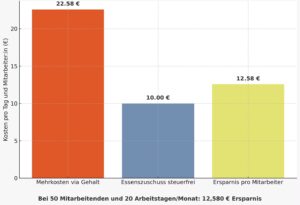
If an employee pays the €10 out of their own pocket, the employer has additional gross costs of €22.58 per meal (incl. non-wage labor costs). With the tax-free meal allowance, however, only the actual €10 cost is incurred. This results in a daily saving of €12.58 per employee.
For a team of 50 employees over 20 working days per month, this results in a potential saving of €12,580 per month. With Schrankerl, companies can use this benefit directly without administrative hurdles – a clear win for both employers and employees.
The calculation impressively demonstrates that small amounts at the corporate level can lead to enormous savings. Even with smaller allowances, the saved costs add up to significant sums over months and years.
What Would a Meal Allowance Cost in Your Company?
The exact savings depend on the number of employees, the desired allowance amount, and the tax bracket. With our free meal voucher calculator, you can see in a few seconds how much your company actually saves with each model – calculated individually for your team size.
Why Tax-Free Employee Catering Is Advantageous for Employers
Direct Cost Savings for Companies
As already shown, companies have the opportunity to bypass high non-wage labor costs with the help of the meal allowance. In Austria, these amount to approximately 27% of gross earnings – a salary increase thus causes high costs for both parties. A tax-free allowance, on the other hand, reaches employees as a net benefit and places significantly less strain on the company budget.
Strengthening Motivation and Employer Brand
There are also “soft factors” to consider: healthy catering demonstrably leads to an increase in motivation and productivity, while an appealing catering offer strengthens the employer brand. According to surveys, almost two-thirds of employees look for meal offers when choosing a job. Employee catering thus becomes a real competitive advantage that reduces costs and increases the company’s attractiveness.
Simple Practical Implementation
Companies can effortlessly take advantage of these benefits with Schrankerl: fresh meals are delivered directly to the office, billed tax-free, and tailored to the needs of the employees. This results in a benefit that can save costs, promote health, and serve as a clear sign of appreciation.
Employer Meal Allowance: Modern Implementation Options
Different Models for Flexible Needs
The employer’s meal allowance can be implemented in various ways and is not limited to a single model. It is always important that the legal exemption limits are observed. The mentioned benefits can be realized through various approaches: classic meal vouchers (both in physical and digital form), digital credit solutions, direct delivery of food to the office, or company cafeteria and catering models. The most suitable variant depends on the size of the company, its way of working, and the needs of the employees. What matters is: all models can be implemented tax-free and offer flexible options for both employers and employees.
Digital Vouchers & Modern Alternatives
Digital meal vouchers are particularly common. They can be used flexibly in restaurants, supermarkets, or with delivery services and offer employees a wide range of options for using their allowance.
A modern option is also Schrankerl: here, freshly prepared dishes are delivered directly to the office, personal preferences are taken into account, and billing is handled automatically in accordance with tax regulations. Another advantage: Edenred vouchers, for example, can also be redeemed at Schrankerl. This allows employees to benefit from the flexibility of classic vouchers and the convenience of a daily, fresh supply.
Electronic Meal Vouchers: Legal Considerations
Since 2018, digital solutions for meal allowances have been permitted in Austria – meal vouchers no longer need to be issued in paper form. For an electronic voucher to be tax-recognized, the following requirements apply:
- Clear Assignability: Each voucher or transaction must be clearly assignable to a specific person.
- Redemption per Working Day: In principle, the allowance may be consumed once per working day – digital systems automatically ensure that no multiple redemptions occur on the same day.
- No Contractual Partner Requirement: Unlike classic paper meal vouchers, app-based solutions do not require a contractual obligation to specific restaurants – the vouchers are generally redeemable wherever the respective payment solution is accepted.
- Accumulation Possible: Unused daily values may be collected and redeemed cumulatively later – even on weekends or outside of actual working days.
Advantage over Paper Vouchers: No manual printing and distribution effort, no expiration dates that need to be tracked manually afterward, and billing can usually be completed in a few minutes per month via import. Furthermore, a digital solution automatically provides the annual totals per employee required for the new L16 field starting in 2026 (see above).
New from 2026: Meal Allowance Must Be Reported on the Payslip (L16)
For wage payment periods starting January 1, 2026, the Ministry of Finance has revised the annual payslip (L16). A new dedicated field for tax-free meal vouchers according to § 3 Para. 1 No. 17 lit. b EStG has been introduced – previously, this amount did not have to appear separately on the L16.
What This Means for Employers:
- The annual total of tax-free meal allowances granted must be reported separately for each employee in the L16.
- The decisive factor is the inflow for wage tax purposes, i.e., the time of actual payment or redemption – not the date of the order or credit. For example, if a voucher is redeemed in December but only paid out in January, it counts toward the following year.
- The obligation applies to all employees who received tax-free meal allowances during the calendar year – including part-time and marginal employees.
- Transmission is carried out as usual via ELDA, by the end of February of the following year at the latest.
In practical terms, this means: Those who previously only handled the meal allowance “on the side” in payroll accounting should now ensure that the tax-free amounts are documented cleanly and traceably per person – ideally through a digital solution that automatically outputs these totals per employee instead of manually calculating them from receipts.
Why Schrankerl Is Perfectly Suited for a Tax-Free Meal Allowance
Meal allowances can, as mentioned, be implemented in various ways – ranging from traditional vouchers to digital options. Schrankerl offers a particularly appealing model: daily freshly prepared, restaurant-quality dishes without flavor enhancers and preservatives are delivered directly to the company and are accessible to employees around the clock. Cooperation with 18 different partners guarantees variety – from bowls and pasta to snacks and drinks.
Employers can handle it very easily: billing is digital and complies with tax requirements, food preferences can be taken into account, and transparent evaluations facilitate cost control. Employees benefit from the greatest possible flexibility, as meals are available around the clock and the meal allowance can be directly combined with common vouchers such as Edenred – very simply via the card terminal.
Conclusion: Tax-Free Employee Meal Allowance 2026 – Essential & Effective
A tax-free meal allowance is not only a smart financial decision but also a sign of appreciation. It helps companies avoid high non-wage labor costs and gives employees the daily feeling of being able to treat themselves to something good without restrictions. In a working world where more than 64% of applicants value appealing catering offers, it represents a real advantage in the competition for talent.
However, it is about more than just numbers: a good meal increases energy, promotes health, and creates small moments of happiness in everyday work. Whether with digital vouchers or innovative solutions like Schrankerl – the mentioned benefits can be implemented in different ways and offer companies the greatest possible flexibility.
The result: teams that feel motivated, healthy, and loyal, and who feel seen and valued. For employers, this means: fewer absences, increased productivity, and a stronger sense of community in the company. This makes the tax-free meal allowance from 2025 a recipe for success for satisfied employees and a sustainably strong company.
FAQs – Tax-Free Meal Allowance for Employees
The tax-free meal allowance can be utilized by all permanent employees, regardless of whether they work in the office or from home, as long as the meal is consumed during working hours. Part-time employees also benefit from the allowance on a pro-rata basis. Digital allocation via Schrankerl is straightforward: each employee receives their credit or meal voucher directly on the platform, without any additional administrative effort. This ensures that all employees benefit equally from the tax-free meal.
Yes, numerous providers, including Schrankerl, offer the option to carry over unused credits for a specified period. This provides employees with flexibility, for instance, if they do not utilize the service on certain days. At the same time, companies maintain full control over their costs and prevent waste. This ensures that tax-free allowances are utilized in the best possible way.
No, the tax-free meal allowance is only intended for permanently employed staff. Self-employed individuals or freelance workers can deduct their meals for tax purposes, but they must do so themselves. At Schrankerl, they also have the option to obtain meals through paid models. Even external employees indirectly benefit from healthy food, while the tax relief exclusively benefits permanent employees.
With Schrankerl, companies receive a digital, tax-compliant solution for tax-free meal vouchers and other meal programs. The platform handles the direct delivery of food to the office or home office, accommodates personal dietary needs, and simplifies the entire billing process. This reduces administrative effort and ensures compliance with legal requirements. Employees, in turn, benefit from diverse and healthy meals that they can select according to their preferences.
Yes, companies have the flexibility to determine the amount of the tax-free meal allowance based on their budget and team size. At Schrankerl, this can be set digitally, ensuring all employees receive the desired credit. Adjustments can be made quickly, for example, for new team members or special promotions. This keeps the allowance attractive, tax-compliant, and easy to manage.
Yes. Schrankerl is compatible with various benefit services. For example, you can pay directly with your Pluxee/Edenred card.
Companies reduce non-wage labor costs, increase employee motivation, and contribute to health and productivity. According to studies, tax-free meal allowances have a significant positive impact on the working atmosphere and satisfaction. Schrankerl enables a digital and efficient implementation of these benefits. At the same time, employers intensify their employer branding and present themselves as an attractive employer for skilled personnel.
Yes, in Austria, meal vouchers are tax-free up to a value of €8.00 per working day if they are used for meals in restaurants or dining establishments.
If they are used for grocery shopping at a supermarket, the tax-free limit is €2.00 per working day.
Yes! Companies can also utilize tax-advantaged meal budgets with Schrankerl to actively promote healthy eating.
Our Marketing and Event Manager ensures that everyone at Schrankerl loves their lunch. Efficient, creative, and exceptionally organized, she brings a breath of fresh air to every lunch break!