Healthy Office Catering Reimagined: Schrankerl vs. Food Delivery Services
Applications for Modern Office Catering
Both food delivery services and Schrankerl can be used under similar conditions.
For example, when a company:
- is too small for its own company cafeteria
- wants to supplement existing cafeteria food
- wants to offer more variety or all-day office catering
- has only limited space available
Both options are therefore suitable as an alternative or supplement to the classic cafeteria.
Time Expenditure in Office Catering
Ordering food via delivery services is often associated with a high time expenditure. Deciding what and where to order, as well as coordinating with colleagues, takes time and usually needs to be planned in advance. As a result, valuable working time is lost.
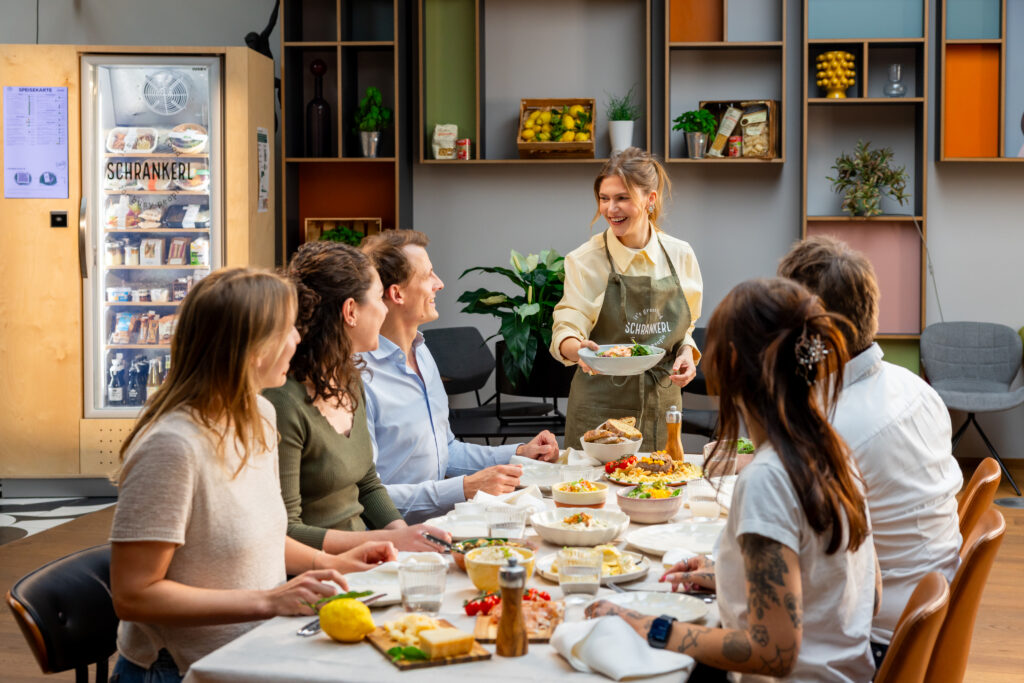
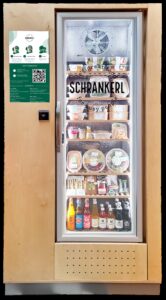
With Schrankerl, this effort is completely eliminated. Depending on the agreement, the office catering is delivered several times a week. During the lunch break, the desired products can simply be taken from the Schrankerl. Payment is automatic, and depending on the dish, the food only needs to be briefly reheated.
Wait Times for Food Delivery Services and Schrankerl
With food delivery services, meals must be ordered in advance. Wait times for delivery vary greatly depending on the provider.
In contrast, the dishes in the Schrankerl are ready at any time. Delivery takes place on delivery days before 12:00 PM, so that the office catering is available right on time for the lunch break—with no wait time at all.
Comparison of Dish Selection
The selection of food delivery services depends heavily on the company’s location. In cities, the range is usually large, while it can be significantly more limited on the outskirts or in rural regions.
In the Schrankerl, there is always a large selection of different dishes:
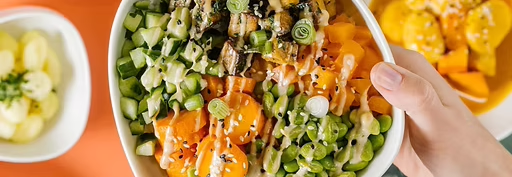
- Bowls
- traditional dishes
- desserts
- snacks
The dishes vary weekly and cover everything that is important for balanced office catering. This ensures there is something for everyone.
Costs of Office Catering
Costs for food delivery services vary greatly depending on the provider. Often, the minimum order value is around $10, plus delivery costs. With several orders per week, these costs quickly add up.
At Schrankerl, the dishes cost no more than $10, with the average price ranging between $5 and $7. Additionally, office catering is often discounted through an employer meal allowance.
Healthy Cafeteria Food vs. Healthy Office Catering
If the selection of food delivery services is small, it is often difficult to find healthy and balanced dishes for the lunch break. The result: the food makes you tired and focus drops significantly.
Due to the variety, Schrankerl always includes healthy dishes. These are filling but not heavy—and support a concentrated and productive second half of the day.
When are Food Delivery Services Suitable for Office Catering?
Both Schrankerl and food delivery services are good solutions for office catering—however, with different areas of application.
Food delivery services are particularly suitable:
- when employees work from home
- when a company has fewer than 30 employees and is too small for a Schrankerl,
In these cases, food delivery services can be a sensible way to still offer catering.
Conclusion: Finding the Right Office Catering
Whether food delivery service or Schrankerl—both solutions have their place. However, those looking for structured, time-saving, and healthy office catering without the daily organizational effort will find a modern alternative to classic cafeteria food with Schrankerl.
Frequently Asked Questions
Yes, the meal allowance for Schrankerl is tax-free in Austria – and even without a daily maximum limit. Schrankerl is considered workplace catering directly at the company, which is not subject to any monetary limit. The employer can cover 100% of the costs without creating a taxable benefit.
Yes! Meal allowances provided through Schrankerl are 100% tax-free. If employees currently pay $10 for their lunch from their net wages, it costs the employer around $22 including non-wage labor costs. With Schrankerl, approximately $12 can be saved per employee per day. For 50 employees, that amounts to over $12,000 per month.
Costs depend on the location, company size, number of fridges, and subsidy model. However, we have a suitable solution for every company and every budget. As soon as we know your specific needs, we will create a customized offer for you. Please contact our team at tasting@schrankerl.at we would be happy to advise you!
Yes, Schrankerl is compatible with various meal benefit services. Simply pay directly at the card terminal with your Pluxee or Edenred card. There are also many other options for meal allowances. We would be happy to advise you.
Yes, Schrankerl offers many different models – all tax-free: 1) A fixed amount per employee per day (e.g., €10) or 2) A percentage-based amount (e.g., 50%). The amounts are automatically applied to each purchase; the company receives a monthly collective invoice. For inquiries, please contact us: tasting@schrankerl.at
By collaborating with over 20 passionate chefs, we are able to offer a wider variety and superior quality. Our partners work without flavor enhancers or preservatives, and many provide organic quality. The dishes are freshly prepared—no frozen meals. The benefit of Schrankerl: 87% of Schrankerl users report that Schrankerl contributes to their long-term well-being.
A Schrankerl is designed to serve 30–150 people. Depending on the company location and usage, however, this number may vary. In the vast majority of cases, one Schrankerl is perfectly sufficient. We would be happy to advise you on the details. Simply contact us at: tasting@schrankerl.at
No, not with AI. However, our planning software is highly intelligent and processes consumption data in real-time, incorporating it into our daily forecast. Our food planning team nevertheless reviews the consumed quantities weekly and adjusts deliveries accordingly. This ensures there is always a sufficient selection available, and we minimize food waste.
Schrankerl is available throughout Vienna, Lower Austria, Burgenland, Upper Austria, Salzburg, Styria, and Carinthia. Please contact us for more details at tasting@schrankerl.at
Only one company can be the contractual partner per Schrankerl. Arrangements between companies are possible, as long as only one company remains the point of contact. In these cases, we can also specifically allocate meal subsidies between the companies.
Installing a SCHRANKERL refrigerator in your company requires only minimal infrastructure. All you need is a standard power outlet near the desired location. A water connection is not necessary, and no special construction work or adaptations are required. Our team handles the delivery, installation, and commissioning of the refrigerator, as well as daily restocking with fresh and varied dishes. We also fully cover maintenance and technical support, ensuring a worry-free catering solution for your company. In short: SCHRANKERL takes care of everything – you and your team simply enjoy a turnkey catering concept that enhances well-being and motivation in the workplace.
Installing a SCHRANKERL refrigerator in your office premises is very straightforward and requires very little space. Our connected refrigerators are designed to integrate easily into any type of work environment—whether in an open-plan office, the coffee kitchen, or the break room. The standard dimensions of a SCHRANKERL refrigerator are approximately: 2 meters high, 1.06 meters wide, and 0.80 meters deep. Thus, a space requirement similar to that of a conventional household refrigerator is perfectly sufficient. With their modern and compact design, our refrigerators adapt visually to your office environment—and quickly become a popular meeting point in the daily work routine. If necessary, the SCHRANKERL can also be integrated and built directly into the kitchen without the outer casing.
Employee retention describes how strongly employees feel connected to a company in the long term and how likely they are to stay despite alternatives. It differs from mere satisfaction, as satisfaction is a momentary feeling, whereas retention is a decision with a view toward the future.
Because turnover is demonstrably expensive: studies estimate the cost per departure at approximately 90 to 200 percent of a gross annual salary. Additionally, a lack of emotional commitment leads to higher absenteeism and lower productivity, even if no one resigns.
The most effective approach is a combination of consistent, appreciative leadership, clear development prospects, and benefits that are easily usable in everyday life. Occasional highlights such as company parties or anniversary gifts additionally strengthen motivation and team spirit – however, for lasting retention, it also requires complementary elements like a regular shared lunch, for example from Schrankerl, that are experienced regularly.
Benefits are a proven and effective tool for employee retention — however, what is crucial is how widely they are actually utilized. A benefit that appears attractive on paper but is cumbersome or rarely usable in daily life only achieves part of its intended effect. Practical, recurring benefits, such as uncomplicated lunch catering, for example from Schrankerl, achieve particularly high utilization rates.
Through key metrics such as the employee turnover rate, the retention rate of new employees after one to two years, the Employee Net Promoter Score (eNPS), and the absenteeism rate. The development of these values over several quarters is crucial, not a single measurement.
In Austria, occupational health and safety laws generally apply to home offices as well. Employers are required to conduct risk assessments and provide suitable work equipment – in practice, this is often handled through cost subsidies or the loaning of equipment.
This largely depends on the nature of the work and individual personality. Many companies find that two to three days in the office per week work well. The crucial aspect is not the number of days, but how they are utilized.
Structure helps more than willpower. Fixed working hours, clear breaks, a quiet workspace, phone stacking (smartphone in another room), and consciously turning off notifications during focus times are proven methods.
Take active countermeasures: regular video calls even without an agenda, virtual coffee breaks, using coworking spaces, and a clear separation between work and leisure time. Anyone who notices that isolation is becoming a burden should address it openly—with colleagues or supervisors.
In Austria, since the 2021 remote work regulations, it has been possible to establish remote work arrangements through works agreements or individual contracts. Currently, there is no statutory legal entitlement to work from home—the employer must provide their consent.
Ideally with planning. Those who know what’s for lunch are less likely to reach for a quick snack. Weekly shopping lists, fixed break times, and consciously leaving the workspace to eat help supply the body with energy without keeping your mind on work.
Employee catering encompasses all organized measures by which a company provides its employees with access to meals or snacks at or near the workplace. This ranges from meal vouchers and catering services to refrigerator systems offering fresh food.
A structured catering solution becomes economically viable for companies with approximately 30 employees or more. Meal vouchers and smart refrigerator systems are also well-suited for smaller teams, as they do not require dedicated infrastructure.
In Austria, meal vouchers or meal allowances can be granted tax-free up to a certain limit (as of 2026: up to €8 per day). The exact amounts and conditions are regulated by the Austrian Income Tax Act. For current figures, it is advisable to consult with a tax advisor or the WKO.
Institutional catering refers to permanently operated catering facilities such as canteens or company restaurants. Corporate catering is usually event-based: Meals are delivered or prepared on-site for an event or a defined period.
Offices with fixed working hours can effectively utilize catering, delivery services, or smart refrigerators . The latter are significantly better suited for shift or production facilities, where employees eat at varying times, requiring systems available around the clock.
Yes. Especially for SMEs without their own cafeteria, flexible concepts without fixed cost risks are attractive. Providers like Schrankerl provide the unit without a setup fee – the risk lies with the provider, not the company.
Yes, under certain conditions. Meals provided directly at the workplace are generally not considered a taxable benefit in kind. Meal vouchers can be granted tax-free for wage tax and social security contributions up to a legally defined daily maximum amount, which will be up to €8.00 per working day in 2026. Since the exact amounts and conditions can change regularly, individual consultation with a tax advisor or a review of the current information from the WKO is recommended.
For small and medium-sized enterprises (typically up to 100–150 employees), meal vouchers and smart fridge solutions are the most suitable. Both models require no dedicated kitchen infrastructure, are flexibly scalable, and can be designed to provide tax advantages. A smart fridge becomes economically viable starting at approximately 30 employees.
This depends heavily on the chosen model. Meal vouchers typically cost 4–8 € per workday, which amounts to 80–160 € monthly per person. Smart fridge meals usually range between 5 and 10 € per portion. With tax optimization, the effective costs for the employer are significantly reduced, as ancillary wage costs are eliminated.
The most important alternatives to a classic company cafeteria are: meal vouchers (e.g., Edenred), smart fridges (e.g., Schrankerl), external catering, delivery services, and well-equipped office kitchens. The best solution depends on team size, location, budget, and the eating habits of the workforce. In many cases, a combination of a smart fridge and a meal allowance is chosen.
Daily, tangible benefits, such as a subsidized lunch, increase appreciation for the employer. They create positive daily experiences, encourage the use of breaks, and strengthen social cohesion within the team. Employees who feel well-cared for and valued are less inclined to leave, which, in turn, reduces turnover and recruiting costs.
Yes. Meal vouchers are excellent for remote employees, as they can be redeemed regardless of location. Smart fridges in the office complement the offering for everyone who is regularly on-site. A combination of both models covers hybrid work situations effectively.
Sustainability is gaining importance for employees and companies alike. Solutions that reduce food waste, collaborate with regional producers, and focus on minimizing packaging are becoming increasingly relevant. Smart fridge concepts like Schrankerl offer structural advantages in this regard through demand-driven stocking and optimized delivery logistics.
Employee benefits are all additional services that employers offer beyond the agreed salary. These include, for example, meal allowances, remote work, professional development, public transport passes, occupational pension plans, health programs, and flexible working hours.
Numerous benefits are already tax-free in Austria: meal vouchers up to €8.00/day, public transport tickets for commuting, childcare subsidies up to €2,000/child/year, occupational pension schemes up to €300/year, home office equipment up to a one-time €300, and non-cash benefits up to €186/year. Note: Not tax advice – please consult a tax advisor.
According to surveys in Austria, Germany, and Switzerland, the most attractive employee benefits for 2026 are flexible working hours, remote work, and health promotion. The latter specifically includes workplace meal provisions and an occupational pension plan.
Benefits are worthwhile when they are regularly utilized and genuinely meet the needs of employees. In practice, meal allowances, public transport passes, and flexible working hours demonstrate the highest utilization rates and appreciation.
In Austria, flexible working hours, remote work, and health benefits, such as meal allowances and retirement provisions, are the most widespread and popular.
Small and medium-sized enterprises benefit particularly from easy-to-implement and tax-advantaged benefits: meal allowances, the KlimaTicket, home office, flexible working hours, and corporate benefits platforms.
Company culture — often referred to as corporate culture or organizational culture — is a system of shared values, beliefs, behaviors, and unwritten rules that the company represents both internally and externally. It demonstrates how employees interact with one another and how decisions are made. With a strong company culture, employees are proud of their work and are more motivated. They feel understood and integrated, and the leadership style is transparent.
To strengthen corporate culture, elements such as clear values communication, leadership development, genuine and transparent appreciation, meaningful rituals like shared lunch breaks, flexible work models, feedback culture, and material benefits like high-quality employee catering directly in the office should be available.
74% of Austrian employees report being more satisfied in the long term thanks to workplace catering. A communal lunch fosters informal exchange among employees and thus builds trust. According to a University of Warwick study, satisfied employees are 12% more productive, which directly contributes to the company’s economic and cultural goals.
Yes! In Austria, employee catering provided directly at the company is not subject to any monetary limit. Employers can cover 100% of the costs for high-quality office catering — like Schrankerl — without creating a taxable benefit for employees.
A strong corporate culture is created through the interplay of leadership’s trust and credibility, respect, fairness, and psychological safety, shared values and a lived sense of purpose, recognition and appreciation, as well as rituals and tangible symbols in daily work life.
In German-speaking countries, company culture and corporate culture are synonyms and can be used interchangeably. Both describe the lived values, norms, and behaviors within an organization.
Veganuary is an international initiative that invites people every year to consciously switch to a plant-based diet during the month of January. The goal is to make the transition to vegan nutrition easier and to demonstrate how diverse, practical, and enjoyable plant-based food can be. Many people use Veganuary to try new dishes, reflect on their eating habits, and make more sustainable choices in their daily lives—including in the workplace.
For Veganuary, selected food partners are collaborating with Schrankerl to support plant-based office catering. Participating partners include George Deli & Café, Rita Bringt´s, and BRoK. These partners provide vegan main courses during Veganuary, which are available directly through Schrankerl in your office. The dishes are freshly prepared, diverse, and perfectly designed for lunch breaks during your workday.
Yes, throughout Veganuary, companies and employees benefit from a 10% discount on selected vegan main courses from participating food partners. The promotion makes it particularly easy to try plant-based dishes at the office and discover new favorites. The discount applies automatically to the corresponding main courses in the Schrankerl and significantly lowers the barrier to entry for vegan and vegetarian office catering.
No, Schrankerl is not a traditional catering service. Schrankerl is a modern refrigerator solution for offices that is regularly stocked with fresh dishes from selected food partners. Employees can take their meals directly from the refrigerator at any time — regardless of break times or pre-orders. This makes Schrankerl a flexible, uncomplicated, and contemporary form of office catering, ideally suited for modern work models.
Modern office catering includes flexible, always-accessible meals made from fresh, high-quality ingredients. It takes various dietary styles into account—from classic to vegetarian and vegan—and helps employees eat healthily and conveniently. In this way, office catering becomes an indispensable part of a modern workday.
Good office catering has a demonstrable positive impact on satisfaction, motivation, and productivity. Companies benefit from a reduced number of sick days, greater team cohesion, and an improved perception in employer branding. Investing in high-quality catering is a sign of appreciation, which has an immediate impact on company culture.
Schrankerl provides a smart, intelligent office refrigerator that is stocked daily or as needed with fresh, regional meals. Employees select their meals directly at the device or via the app, pay digitally, and open the refrigerator by scanning—no pre-ordering or organizational preparation is required. Data-driven restocking reduces food waste, and any surplus food is donated.
A balanced diet directly influences concentration, energy levels, and performance. Fresh, nutrient-rich meals prevent the typical afternoon slump, increase mental clarity, and support a more stable immune system. Teams feel fitter and more balanced, and their way of working is demonstrably more efficient. This represents a significant advantage for any work environment.
Yes, in Austria, meal vouchers are tax-free up to a value of €8.00 per working day if they are used for meals in restaurants or dining establishments.
If they are used for grocery shopping at a supermarket, the tax-free limit is €2.00 per working day.
Meal vouchers consist of monetary values, whereas Schrankerl provides real, freshly prepared meals.
Selected regional food partners prepare the dishes fresh every day and then deliver them directly to the company’s Schrankerl refrigerators.
This provides employees with varied and healthy meals directly at their workplace, without the need for shopping or planning.
Schrankerl is a great alternative to a canteen because it requires no kitchen, no staff, and no renovations. Schrankerl operates digitally, saves space, and offers the same quality as a canteen – just smarter.
The terms “meal voucher” and “meal coupon” are mostly used synonymously and refer to the same tax-advantaged model—even the law does not clearly distinguish between the two terms. In common usage, “meal coupon” often refers to the classic individual paper token, while “meal voucher” is now used as a generic term that also includes digital and card-based solutions. For companies, the designation is not what matters; what is decisive is whether the tax limits (€8.00 for restaurants / €2.00 for supermarkets per working day) are observed.
Modern employee catering promotes satisfaction, health, and motivation within the team. Those who eat well work with better focus, remain productive, and have fewer absences. At the same time, an appealing catering offering contributes to strengthening employee retention and employer branding.
Furthermore, digital and flexible solutions make the entire process virtually effortless—an advantage that is actually utilized and benefits everyone.
Yes! Companies can also utilize tax-advantaged meal budgets with Schrankerl to actively promote healthy eating.
Healthy canteen food consists of fresh, balanced, and nutrient-rich dishes—ideally sourced regionally and without additives. In this way, the body receives a sustainable supply of energy to remain focused.
Examples include: fresh fruit and vegetables, nutrient-rich dishes with proteins and complex carbohydrates, regional ingredients, and few artificial additives. With such a diet, employees can actually use their lunch break to recharge their strength—and remain fit, concentrated, and productive for the rest of the workday.
Modern company cafeterias offer more than just lunch: they promote concentration, motivate employees, and can even reduce the number of sick days. A healthy and balanced diet contributes to performance and fitness. This is immediately noticeable in everyday office life.
Above all, a first-class cafeteria strengthens the team community: shared lunch breaks facilitate exchange, increase satisfaction, and contribute to a pleasant working atmosphere.
A well-organized company kitchen therefore pays off twice—both for the employees and for the company.
A flexible catering system represents a good alternative to the traditional cafeteria. This includes digital refrigerators (such as Schrankerl), catering services, or hybrid models that combine different meal options. With such solutions, employees gain more flexibility and can enjoy fresh, healthy meals, while the organizational effort for the company is reduced.
A varied meal plan, regular employee feedback, and the introduction of sustainable catering concepts contribute to successful healthy eating in the office. This approach supports healthy eating habits and enhances job satisfaction and motivation.
A company cafeteria enhances employee well-being, strengthens team spirit, and positively impacts productivity. It is a central component of modern employee catering and makes companies more attractive as employers.
Sustainable cafeterias rely on regional and seasonal ingredients, reduce food waste through thoughtful portion sizes, and use eco-friendly packaging—making corporate catering more ecological.
Key trends include personalization (e.g., Keto, vegan, gluten-free), digitalization through AI-powered ordering systems, and a growing focus on healthy, balanced nutrition in the workplace.
The cafeteria reflects a company’s values and fosters employee cohesion. As a neutral space without hierarchies, it is often where the best ideas emerge and stronger relationships between teams are built.
Especially during challenging times, a reliable canteen provides stability and security. It remains a place for community and strengthens cohesion, particularly when unity is paramount within the company.
The cost of a traditional cafeteria heavily depends on personnel, rent, and equipment, and is often significantly higher than modern alternatives. Solutions like Schrankerl offer cost-effective employee catering entirely without on-site personnel and without the high fixed costs of a traditional cafeteria.
In addition to the traditional cafeteria, more and more companies are turning to smart alternatives such as food vending machines, meal vouchers, or digital catering solutions. Schrankerl combines fresh, regional dishes with smart technology – entirely without the need for dedicated cafeteria staff.
The tax-free meal allowance can be utilized by all permanent employees, regardless of whether they work in the office or from home, as long as the meal is consumed during working hours. Part-time employees also benefit from the allowance on a pro-rata basis. Digital allocation via Schrankerl is straightforward: each employee receives their credit or meal voucher directly on the platform, without any additional administrative effort. This ensures that all employees benefit equally from the tax-free meal.
Yes, numerous providers, including Schrankerl, offer the option to carry over unused credits for a specified period. This provides employees with flexibility, for instance, if they do not utilize the service on certain days. At the same time, companies maintain full control over their costs and prevent waste. This ensures that tax-free allowances are utilized in the best possible way.
No, the tax-free meal allowance is only intended for permanently employed staff. Self-employed individuals or freelance workers can deduct their meals for tax purposes, but they must do so themselves. At Schrankerl, they also have the option to obtain meals through paid models. Even external employees indirectly benefit from healthy food, while the tax relief exclusively benefits permanent employees.
With Schrankerl, companies receive a digital, tax-compliant solution for tax-free meal vouchers and other meal programs. The platform handles the direct delivery of food to the office or home office, accommodates personal dietary needs, and simplifies the entire billing process. This reduces administrative effort and ensures compliance with legal requirements. Employees, in turn, benefit from diverse and healthy meals that they can select according to their preferences.
Yes, companies have the flexibility to determine the amount of the tax-free meal allowance based on their budget and team size. At Schrankerl, this can be set digitally, ensuring all employees receive the desired credit. Adjustments can be made quickly, for example, for new team members or special promotions. This keeps the allowance attractive, tax-compliant, and easy to manage.
Yes. Schrankerl is compatible with various benefit services. For example, you can pay directly with your Pluxee/Edenred card.
Companies reduce non-wage labor costs, increase employee motivation, and contribute to health and productivity. According to studies, tax-free meal allowances have a significant positive impact on the working atmosphere and satisfaction. Schrankerl enables a digital and efficient implementation of these benefits. At the same time, employers intensify their employer branding and present themselves as an attractive employer for skilled personnel.

Our Marketing and Event Manager ensures that everyone at Schrankerl loves their lunch. Efficient, creative, and exceptionally organized, she brings a breath of fresh air to every lunch break!